
In hindsight, it is easy to see how the whole thing was cursed from the start for the South Africans. The 1972 International Surfing Federation (ISF) World Surfing Championships had originally been scheduled for the North Shore of Oahu. It would have been the first time the eight-year-old event had taken place in Hawaii, the spiritual epicentre of the sport. But it was not to be.
The ISF World Contest had previously been held in Sydney, Australia, in 1964; Lima, Peru, in 1965; San Diego, California, in 1966; Rincon, Puerto Rico, in 1968 – and again in Australia at Bells Beach in 1970. Bells Beach was itself a last-minute venue change, after the event had been scheduled for and then cancelled in Hawaii in 1969, ostensibly due to permit reasons.
Most in world surfing felt it was long overdue that the sport’s premier event should be held in the North Shore of Hawaii’s most formidable surf breaks, such as Pipeline and Sunset, in order to crown a world champion in waves of consequence.
But, less than two months before the event was due to start, again due to problems with permits and sponsors, the ISF announced to all participating nations that the ‘72 World Champs had to be moved back to the location of the ’66 event, San Diego.
This went against the organisation’s mandate to hold events in new venues to spread surfing around the world. The last minute venue shift was just also just the start of the chaos surrounding this doomed contest – and the imminent demise of the ISF.
“They are a happy fun-loving group. It is super to be along with them and I certainly hope we have the world champ with us.”
John Whitmore’s wife, Thelma, who travelled with the Springbok team to San Diego in 1972.
The Flying Springboks
John Whitmore had initially focused his energy on picking the best Springbok team for Hawaii in a series of trials in July 1972, which were held in the mostly neutral territory of the Eastern Cape.
More than ever, John was keen to get at least one Springbok surfer into the final, as they had come painfully close several times. Apart from 1966, at least one South African had made the semi-final of every ISF world contest, including Shaun and Mike Tomson in Australia 1970, the team’s best result overall so far.
Following Gavin Rudolph’s massive win at the Smirnoff Pro-am in Oahu in late 1971 – the first for a South African in an international event – the Springboks were poised to finally break through to the very top ranks of the world surfing elite.

The 1972 Springbok surfing trials were held in solid waves at Buffalo Bay in the Eastern Cape and culminated in firing six foot Supertubes at Jeffreys Bay. Clipping courtesy Whitmore Family Collection.
The 1972 Springbok surfing team announced shortly afterwards was regarded as the best South Africa had ever lined up for an ISF world contest. Gavin easily made it as first seed, joined by Johnny, Shaun and newcomers Anthony Brodowicz, Mike Esposito and Mike Larmont, along with ladies Sally Sturrock and Phillipa Sales.
But the Springbok surfers had been disappointed when they found out soon afterwards that the 1972 ISF event had suddenly been moved to San Diego. Yet such was the depth of talent in the team that the widespread belief was that their potential and ambition would see them through – no matter what the surf was like.
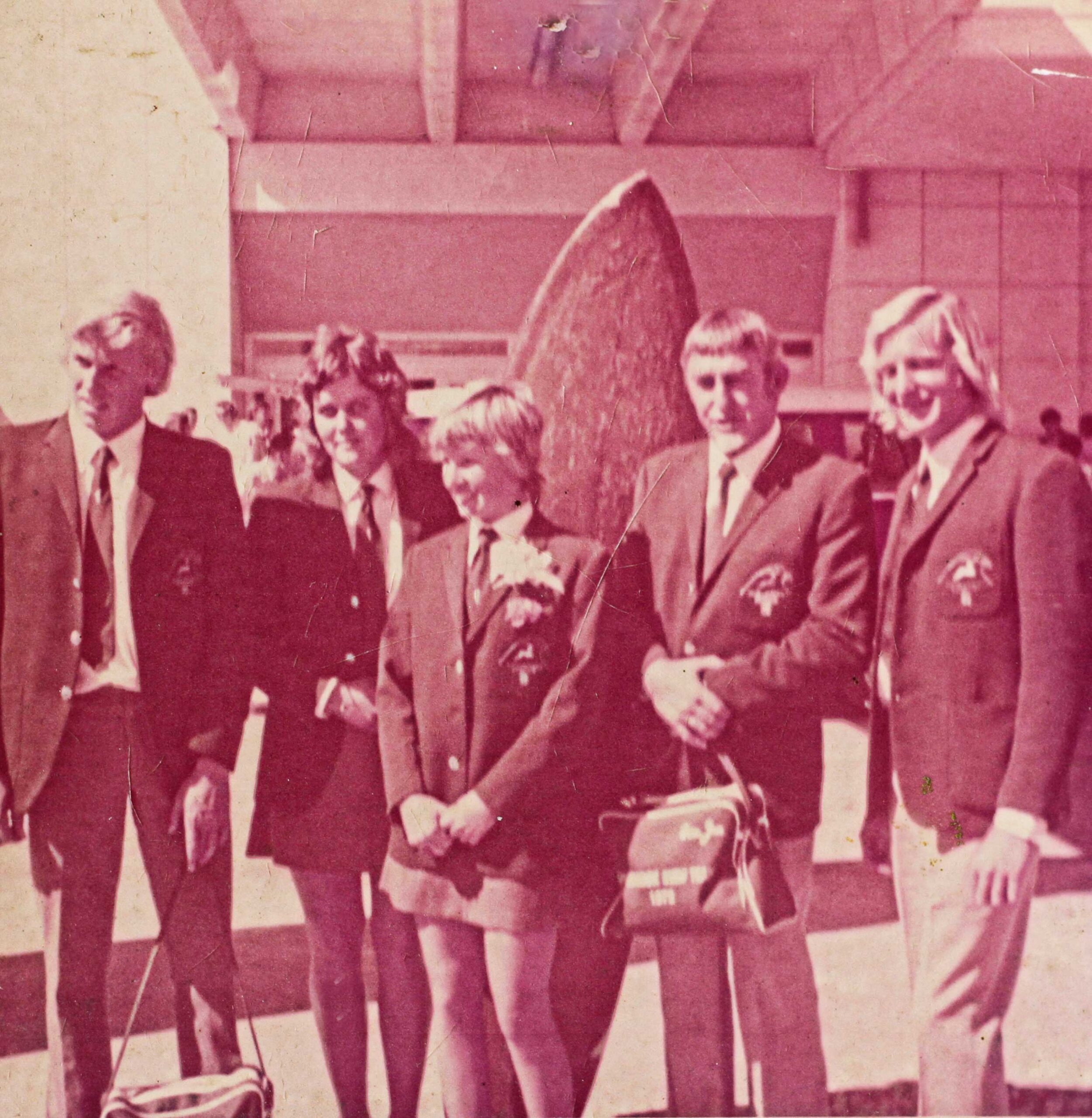
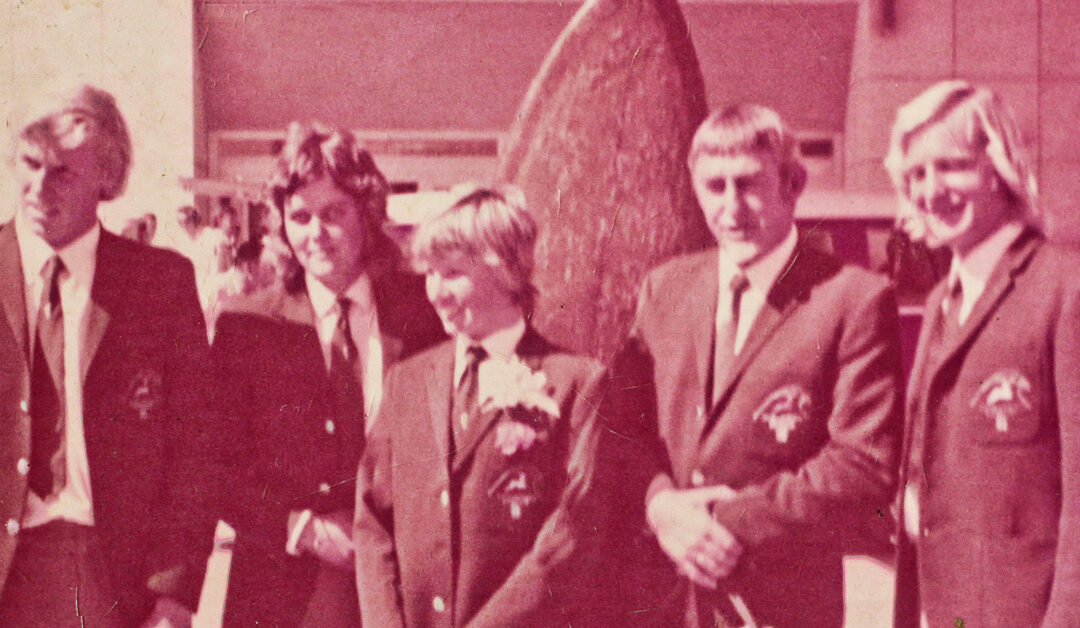
The Cape Town members of the 1972 Springbok surfing team, from left semi-finalist and top placing South African, Johnny Paarman, Pippa Sales, Sally Sturrock, team manager John Whitmore and 1971 Smirnoff Pro winner Gavin Rudolph. Image courtesy Whitmore Family Collection.
Determined to better their previous results, John had arranged for the team to fly to the US several weeks before the event to practice in the event venues and become accustomed to their surroundings. Durbanite Graham Hynes debuted as travelling judge and coach and John reassumed the role of manager. They were accompanied for the first time on an international trip by John’s wife Thelma, who wrote home to her family: “They are a happy fun-loving group. It is super to be along with them and I certainly hope we have the world champ with us.”
However, the South Africans’ upbeat spirit was smashed like a close-out on dry reef when they landed at LAX and found out that the 1972 ISF World Surfing Championships would in all likelihood not go ahead.Fortunately the president of the California-based Western Surfing Association, Dr Robert Scott – and to a lesser degree Gordon Clark of Clark Foam – stepped in and offered to sponsor the event. Frantic messages were urgently sent telling the competing countries to get to San Diego by the new starting date, just over a week later.
Fear and Loathing
Though the event was now back on, the upheaval was merely a portent of far worse to follow. For a start, while the contest administration argued over money and blame in the Harbor Island Travel Lodge in the urban heart of San Diego, the surf at their proposed venues had been pumping. Now, as the event was due to start, the swell had turned to the south and the northeast-facing competition venue was dribbling forth in barely contestable slop.

The 1972 ISF contest was mostly held in small, sloppy surf.
Instead of being known solely for the act of surfing, the 1972 World Contest would also become notorious for the off-beach shenanigans of the surfers, groupies and assorted hangers-on. Long-haired, psychedelic-hued hippiedom had now completely taken over the sport, which was now practically unrecognisable from the 1966 event at the same venue.
Wild parties raged every night and so much cocaine was on offer, surf journalist Drew Kampion, the editor of Surfing magazine, observed drily in his post-contest report that “there was even the occasional snow flurry to break up the weather pattern in the hotel.”
While the solid south swell pumped into the Southern California coast for the duration of the event, most of it passed San Diego by. Instead, the competitors had to endure mostly substandard surf, across a gruelling format of several qualifying heats.
Selected to compete in massive Hawaiian surf, the Springbok team fared poorly through the early rounds. Fortunate enough to surf their qualifying heats on one of the best days of the contest, Johnny Paarman and Shaun Tomson managed to progress to the semi-finals.

Capetonian Johnny Paarman at the 1972 ISF World Contest.
Thanks to their standout performances to that point, anticipation that one of them might make the final – and even win the contest – nonetheless ran high among the South Africans. But Johnny and Shaun battled in the small, sloppy waves on the final day and finished eighth and ninth, respectively.
While still a solid result, overall the Springboks could not help be disappointed. Apart from Johnny and Shaun, they had all been unable to rise above the poor surf and deliver definitive performances, and most were beaten by the big-name surfers by the narrowest of margins in every round, in what many felt were some questionable judging calls.
“We had good surfers. We had Espo, we had Anthony and Shaun and Gavin,” coach Graham Hynes summed up the sentiment. “And ja we had a bit of bad luck, or it wasn’t bad luck, it was just that the judges were the judges and that was that.”

As president of the South African Surfriders Association and a member of the ISF executive, John Whitmore played an enormous role in world competitive surfing in the late 1960s and early 1970s. Here he is in San Diego, likely just after judging a heat or spotting for a team member – organised as always with his cooler bag.
The judging had been a bone of contention for most other competing nations, too. While Hawaiian Jimmy Blears won the 1972 ISF World Title in the weak, small waves, many felt that American teenager David Nuuwiha – like many surfers at the event riding a small twin fin ‘fish’ surfboard – should have taken first place. “I judged the final and I thought he had won that heat instead of Blears,” said Graham.
Nuuwiha had been forced to ride a borrowed board on the final day, as his own surfboard had been mysteriously stripped of its fibreglass matting and hung from the Ocean Beach pier, replete with a large knife embedded deep into the foam core, on the morning of the finals. Broken in two pieces, someone had inscribed the sardonic message “Good luck Dave” in black felt tip pen on the deck.
The cause of the ominous dangling board was never fully determined. Suspicions ranged from the local anti-contest brigade protesting the presence of the event at their home beach, to rivals intent on sabotaging Nuuwiha.
“Everyone there knew there would never be another world contest. The professional scene was taking over. The surf was really bad in that contest and it wasn’t mobile, which is a pity because there was eight foot surf only an hour away.”
1972 ISF World Contest semi-finalist, Johnny Paarman.
Another theory was that some of the San Diegan surfers had objected to the fact that Nuuwiha was riding a short, stubby twin fin ‘fish’ surfboard– a revolutionary design popularised by San Diego native surfboard shaper Steve Lis. Apparently, the locals claimed exclusive ownership over the design and felt only their surfers should be riding a fish, prompting the incident. Others felt it was simply a bad joke, a stupid prank gone wrong. Whatever the cause, it had the desired effect and Nuuwiha lost.
When the Springbok team arrived on the final day to support Johnny, Graham had wanted to remove the knife as a memento – but was dissuaded from doing so by John, who didn’t want to stir up any more disruption at the troubled event.
“We go down to the beach one morning early and there is a big sign and there is a surfboard hanging off the pier, Oceanside with a knife in it… and I tried to get the knife out and John said ‘oh no Hynesie, just leave it please, don’t take the knife out.’ I wanted it as a souvenir.”
The Beginning of The End
The ensuing controversy over the final result rounded out an event that had been cursed from the start. Hobbled by money woes, delays, bad weather, poor surf and logistical issues, the world contest was also widely considered to be the most poorly organised since its inception.
To the surfers and officials it was obvious the 1972 World Surfing Championships would be its last and that the organisation would not continue for much longer.
“At that contest, the amateur side of world surfing was on its way out,” said Jonathan Paarman. “Everyone there knew there would never be another world contest. The professional scene was taking over. The surf was really bad in that contest and it wasn’t mobile, which is a pity because there was eight foot surf only an hour away.”
The old international surfing paradigm was also rapidly being eroded by the twin forces of surfing for money on the one hand, and the equally strong movement towards anti-contest or ‘soul’ surfing on the other. The tension eventually forced the surfing body’s embattled president Eduardo Arena to resign – and the ISF was immediately dissolved. “We wanted to stay amateur,” Eduardo recalled, “but we knew professional surfing was coming.”
The 1972 World Surfing Championships were also the last of the three ISF events John Whitmore attended as Springbok team manager. In 1973, John tendered his own resignation as president of SASA and transferred his considerable energy to building another new water sport in South Africa – one that would ultimately bring home to the country a world champion in the late 1970s: Hobie Catting.
To watch a video edit of the 1972 event click here: https://vimeo.com/55582714
By Miles Masterson
Get a copy of ‘The Oom’

‘The Oom – The Biography of South African Water Sports Pioneer John Whitmore’ is the illustrated life story of a man who made a massive impact on several ocean-based water sports in the country from the 1950s to the 1980s.
Buy a numbered copy, signed by the author that comes with a limited-edition Whitmore Surfboards sticker for R495.